Claude Opus 5 vs. Fable 5: Near-Equal AI Performance at Half the Cost
 Written by
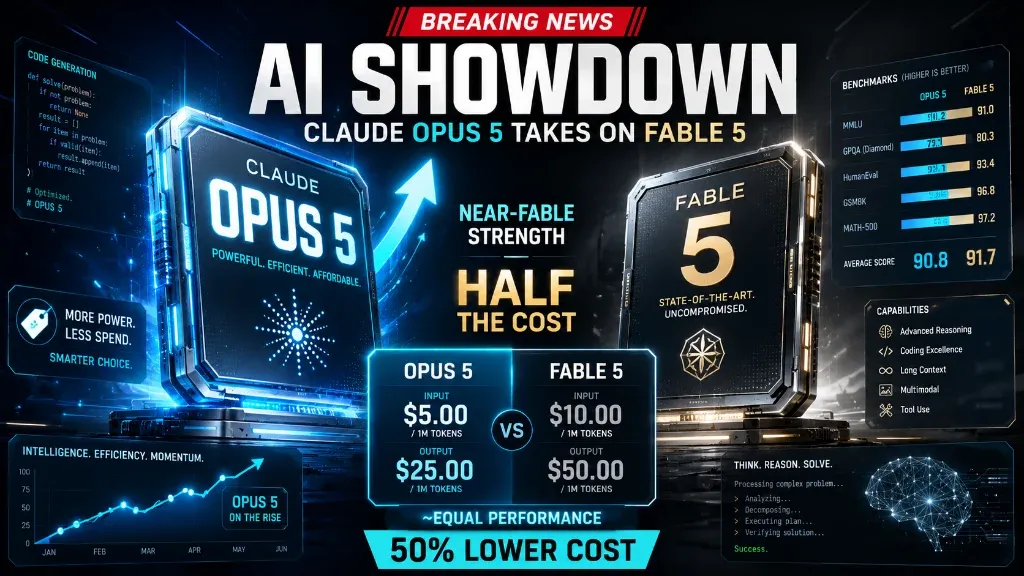
CLAUDE OPUS 5 CRASHES FABLE’S VIP PARTY — Nearly the Same AI Muscle for HALF the Price!
Anthropic’s newest artificial-intelligence heavyweight is here—and Fable 5 may want to keep one digital eye open.
Claude Opus 5 just strutted onto the AI scene like it owns the place—and judging by the early benchmark numbers, that confidence may be completely justified.
Anthropic officially released Claude Opus 5 on July 24, promising something developers have been begging for: performance approaching the company’s elite Fable 5 model, but without the wallet-crushing Fable price tag.
Translation? Champagne intelligence on an Opus budget.
OPUS 5 GETS DANGEROUSLY CLOSE
The headline number comes from CursorBench 3.2, where Anthropic says Opus 5 at maximum effort finished within just 0.5 percent of Fable 5’s peak score—while costing approximately half as much per task.
That is not Opus standing somewhere in Fable’s shadow. That is Opus practically leaning over Fable’s shoulder, copying its lunch order and asking why everybody is still paying double.
The base API pricing tells the story:
- Claude Opus 5: $5 per million input tokens and $25 per million output tokens.
- Claude Fable 5: $10 per million input tokens and $50 per million output tokens.
Same company. Same model generation. Nearly Fable-level performance on major coding tests. Half the listed token price.
THE BENCHMARKS ARE ABSOLUTELY SHOWING OFF
Opus 5 did not merely arrive with a slightly better report card. According to Anthropic’s published testing, the model:
- Finished ahead of every competing model on Frontier-Bench v0.1.
- More than doubled Opus 4.8’s Frontier-Bench performance while achieving a lower cost per completed task.
- Scored three times higher than the next-best model on ARC-AGI 3.
- Produced approximately 1.5 times the next-best pass rate on Zapier AutomationBench at the same cost per task.
- Beat every other tested model on OSWorld 2.0 at comparable costs.
- Surpassed Fable 5’s best OSWorld result while spending only a little more than one-third as much per task.
Read that last one again: Opus reportedly beat Fable’s best computer-use result for roughly one-third of the cost.
That is the AI equivalent of arriving in coach, beating the first-class passenger to the destination and somehow having enough cash left over for dinner.
CODERS MAY HAVE A NEW FAVORITE
Anthropic is pitching Opus 5 as its everyday premium model for serious software engineering, autonomous agents and professional work.
The model is designed to plan larger projects, operate across complex codebases, use multiple tools and verify its own work instead of immediately declaring victory after fixing only the most obvious symptom.
During one evaluation, Anthropic says Opus 5 was asked to reconstruct a machine component as a 3D FreeCAD model—but was not given a normal way to inspect the original drawing.
Rather than throwing up its virtual hands, the model reportedly created its own computer-vision pipeline, extracted the geometry from the raw image pixels and rebuilt the component. Competing models failed to complete the same challenge after five attempts.
In another test, Opus 5 diagnosed the underlying cause of a real software bug and caught an edge case missed by the existing community patch. A competing system reportedly addressed only the surface-level symptom.
That may be Opus 5’s biggest flex: it does not simply write code—it checks whether the code actually solved the problem.
IT ISN’T ONLY ABOUT CODE
Opus 5 is also posting sizable improvements in scientific analysis, finance, legal work, document creation and business automation.
Anthropic reports that the model improved on Opus 4.8 across all of its life-sciences evaluations. It scored 10.2 percentage points higher on an internal organic-chemistry benchmark and 7.7 points higher on a protein-function prediction test.
Early business testers reported gains in data analysis, due diligence, financial modeling, contract redlining and long-form presentation creation. One evaluator said Opus 5 completed difficult finance tasks with higher accuracy, one-third fewer tool calls and 60 percent less time.
SO, IS OPUS 5 ACTUALLY EQUAL TO FABLE 5?
On certain important coding and computer-use benchmarks, it appears extremely close—and in some cost-adjusted comparisons, Opus 5 looks like the smarter purchase.
But Fable 5 has not been completely knocked off its throne. Anthropic still positions Claude Fable 5 as the stronger option for its most ambitious, long-running projects. Fable and the restricted Mythos model also remain ahead in some advanced cybersecurity and biological-research tasks.
So no, Opus 5 is not universally identical to Fable 5.
But for developers who need elite coding, computer control, research and agent performance every day, the gap may now be small enough to make Fable’s double-sized bill difficult to justify.
FASTER—BUT IT’LL COST YOU
Anthropic is also offering an optional Fast mode that runs Opus 5 at approximately 2.5 times its normal speed. There is a catch: Fast mode costs twice the standard Opus rate.
The company has also introduced adjustable effort settings, allowing users to spend more computing power on difficult assignments while lowering effort—and cost—for simpler work.
Opus 5 is available through Claude’s consumer plans, Claude Code and the Claude API. Developers can review the current model and access details on the official Claude Opus product page.
THE BOTTOM LINE
Fable 5 is still Anthropic’s velvet-rope superstar. But Claude Opus 5 just showed up wearing almost the same suit, posting nearly the same coding numbers and charging only half the cover fee.
For most professional developers and AI-agent builders, Opus 5 may be the model that makes the most expensive option suddenly look a little too expensive.
Fable remains the king—but Opus 5 just pulled its chair right next to the throne.
Comments
No comments yet. Be the first to comment!
Leave a Comment