Sam Altman Says AI Has Entered the Singularity — What It Means for the Future
 Written by
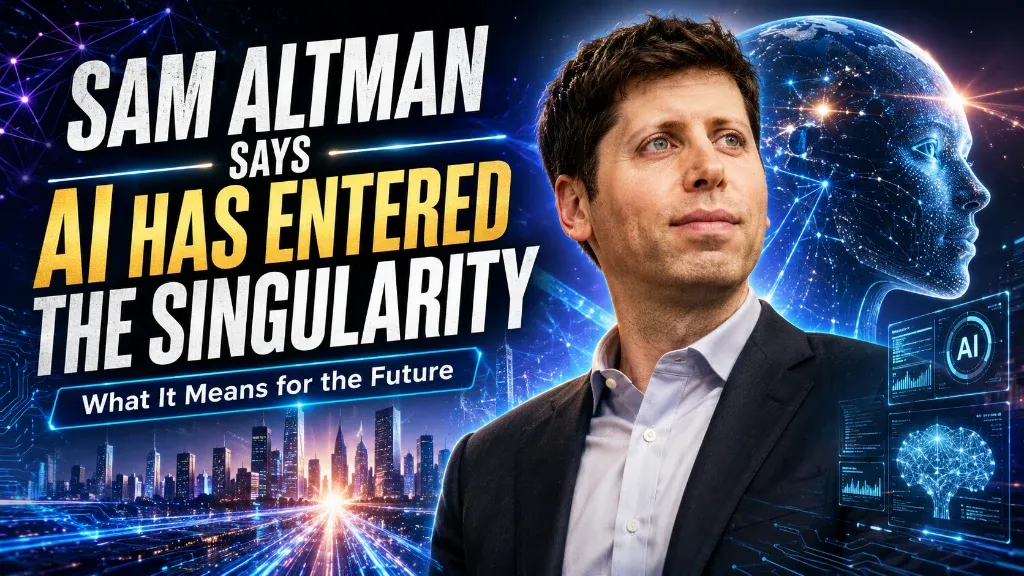
The OpenAI boss says the future everyone joked about over lunch is officially happening.
Sam Altman just dropped one seriously futuristic bombshell — according to the OpenAI CEO, humanity isn’t merely approaching the artificial-intelligence singularity anymore.
We’re apparently already living in it!
Altman made the eyebrow-raising declaration during an appearance on Ti Morse’s Relentless podcast, saying, “We are now, like, in the singularity.” The episode was released Saturday, July 25, 2026, and his statement quickly sparked debate across the technology world.
Yep, you read that correctly. The man leading one of the most powerful AI companies on Earth believes the giant science-fiction moment people have been predicting for decades may have finally arrived.
So, What the Heck Is the Singularity?
The technological singularity is generally described as a point when artificial intelligence becomes more capable than humans and begins advancing so rapidly that people struggle to understand, predict or control what happens next.
Think less “helpful chatbot writing an email” and more “technology changing faster than governments, companies and regular humans can possibly keep up.”
The classic version of the theory involves AI improving its own abilities, triggering a runaway cycle of increasingly powerful machines. But Altman appears to be using the term more broadly — describing a gradual transformation in which AI systems become embedded in research, employment, software development and everyday decision-making.
Altman Says This Was Once Just a Wild Dream
Altman explained that only ten years ago, reaching the singularity felt like a distant and highly unlikely possibility — something technology insiders might casually discuss without seriously expecting to witness.
Now, he says, that formerly unbelievable moment has become reality.
And despite decades of movies depicting superintelligent machines as humanity’s worst nightmare, Altman isn’t acting like someone preparing to hide in an underground bunker. He said he has been waiting for this period his entire life and believes it could be overwhelmingly positive for the world.
Translation: Sam isn’t picturing killer robots marching through Los Angeles. He’s imagining AI accelerating medical discoveries, increasing productivity, creating new companies and helping scientists complete years of research in a fraction of the time.
This Isn’t the First Time He’s Said It
Altman previously laid out a similar argument in an essay titled The Gentle Singularity, writing that humanity was already “past the event horizon” and that the technological takeoff had begun.
In that essay, he argued that modern AI systems are already smarter than humans in certain areas and are significantly increasing the productivity of the people using them. He also described today’s AI-assisted research as an early form of recursive improvement because better AI tools can help researchers build even more capable AI systems.
In other words, the singularity might not arrive with explosions, flashing red lights and Arnold Schwarzenegger showing up in sunglasses.
It may look like millions of people casually using increasingly powerful AI every day until society suddenly realizes the old rules no longer apply.
Not Everyone Is Buying the Hype
Here’s the reality check: Altman’s declaration does not prove that the traditional singularity has occurred.
Current AI systems still rely heavily on humans to supply goals, training data, computer infrastructure, evaluations and permissions. There is no broad scientific agreement that machines have surpassed humanity across every form of intelligence or that AI can independently redesign and improve itself without human involvement.
Some researchers argue that rapid AI progress is real but say calling it “the singularity” exaggerates what existing technology can actually do. Under Altman’s gentler definition, the process may have begun; under the classic definition involving uncontrollable autonomous self-improvement, the evidence remains disputed.
Exciting Future or Billion-Dollar Sales Pitch?
Altman’s statement is guaranteed to fuel both sides of the AI debate.
Supporters will point to models that can write software, analyze enormous datasets, assist scientific research and perform increasingly complicated digital tasks. Critics will argue that the head of an AI company has an obvious reason to convince investors, governments and the public that his industry is building the most important technology in human history.
Either way, one thing is crystal clear: artificial intelligence is developing at breakneck speed, and even the people building it are now using language that once belonged almost exclusively to science-fiction novels.
So, has humanity truly crossed the singularity?
That remains very much up for debate. But according to Sam Altman, the future isn’t knocking at the door anymore.
It has already walked inside, opened a laptop and started working.
Comments
No comments yet. Be the first to comment!
Leave a Comment